
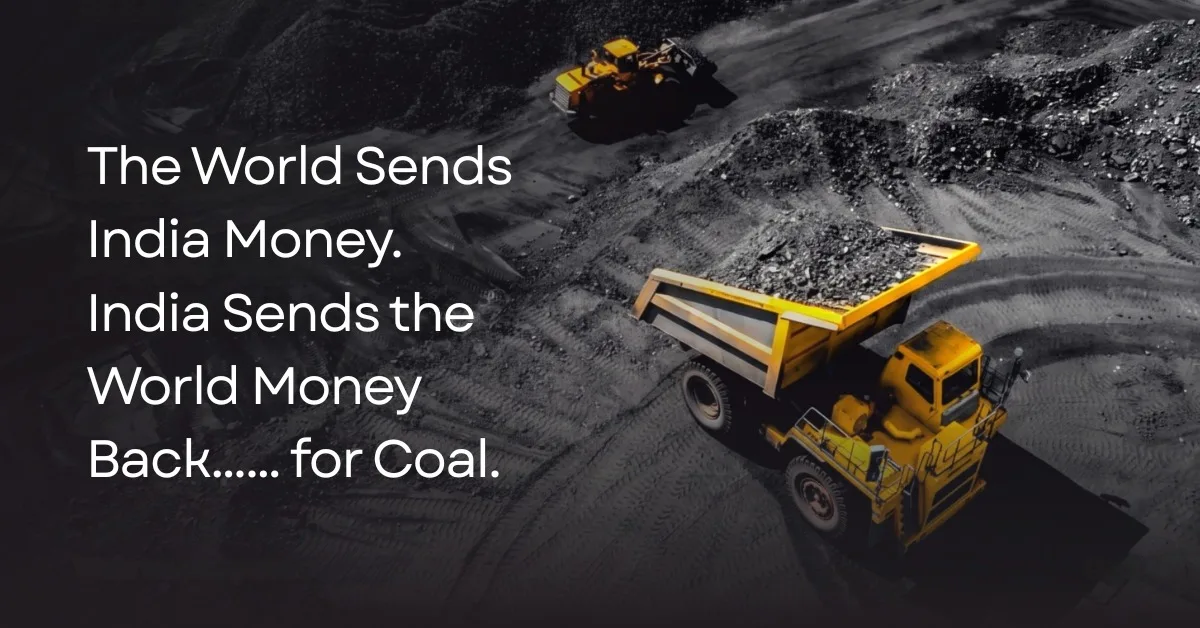
The story Americans hear most often about India's economy circles back to remittances. The billions of dollars Indian professionals abroad send home, the software engineers powering Silicon Valley, the IT exports that keep the rupee afloat. It is a story about India as a supplier of talent, and a beneficiary of the world's spending. But it leaves out a less flattering, more revealing chapter, one in coal imports.
Each year, India spends tens of billions of dollars buying coal from abroad, even as it sits atop the world's fourth-largest reserves of the fuel. In the fiscal year that ended in March 2025, the country imported roughly 243 million tonnes of coal, a figure that, despite falling nearly 8 percent from the year before, still represented one of the largest energy import bills of any nation on earth. Domestic mines cannot easily produce the higher-grade coal that steel and power plants require. So ships from Australia, Indonesia and South Africa continue to arrive at Indian ports by the hundreds. It carries roughly 260 million tonnes a year that blend with local supply to keep factories and turbines running.
It is tempting to read this as a story of dependency. A nation that mines a billion tonnes of coal annually and still cannot feed its own furnaces. But the more accurate story is about appetite. India's industrial base has grown large enough that its hunger for energy has outpaced what its own ground can yield, at least for now.
A Familiar Example, Seen Elsewhere
This is not, in truth, a uniquely Indian predicament. The United States, still the world's largest oil producer, imports crude oil by tanker-load. Germany, Europe's industrial anchor, has spent decades importing the natural gas that keeps its factories humming. Great industrial economies are, almost by definition, entangled in global supply chains for the raw materials that power them.
Vedanta demonstrates this at scale
The mining and metals conglomerate, among the largest in India, still draws close to 70 percent of its total energy from coal, powering the smelters and refineries that produce its aluminum, copper and zinc. CEO Deshnee Naidoo called coal the company’s “baseload contributor”.
It is an acknowledgment of what heavy industry actually demands. It is dependent on a source of power reliable enough to run around the clock, regardless of sunlight or wind. Vedanta's continued reliance on coal is, in miniature, the same calculation India is making at a national level. And that is, accepting that today's industrial base still runs on the older fuel.
A Nation of Buyers, As Much As Sellers
What emerges from this is a more complicated, and arguably more accurate, portrait of India's place in the global economy. It is a country that earns dollars through the export of software and services. Yes, but it is also a country that spends those same dollars purchasing energy on the open market. It is also competing with Japan, South Korea and China for cargoes of coal, in transactions that ripple through prices in Newcastle and Richards Bay.
That makes India not merely an exporter of labor, but a genuine participant on the demand side of the global economy. It is now, less a back office for the developed world, and more an economic actor whose appetite for energy is now large enough to matter globally in its own right.
The bill for that appetite is evidence of exactly how much India has built and how much more, in turn, it now needs to keep running.